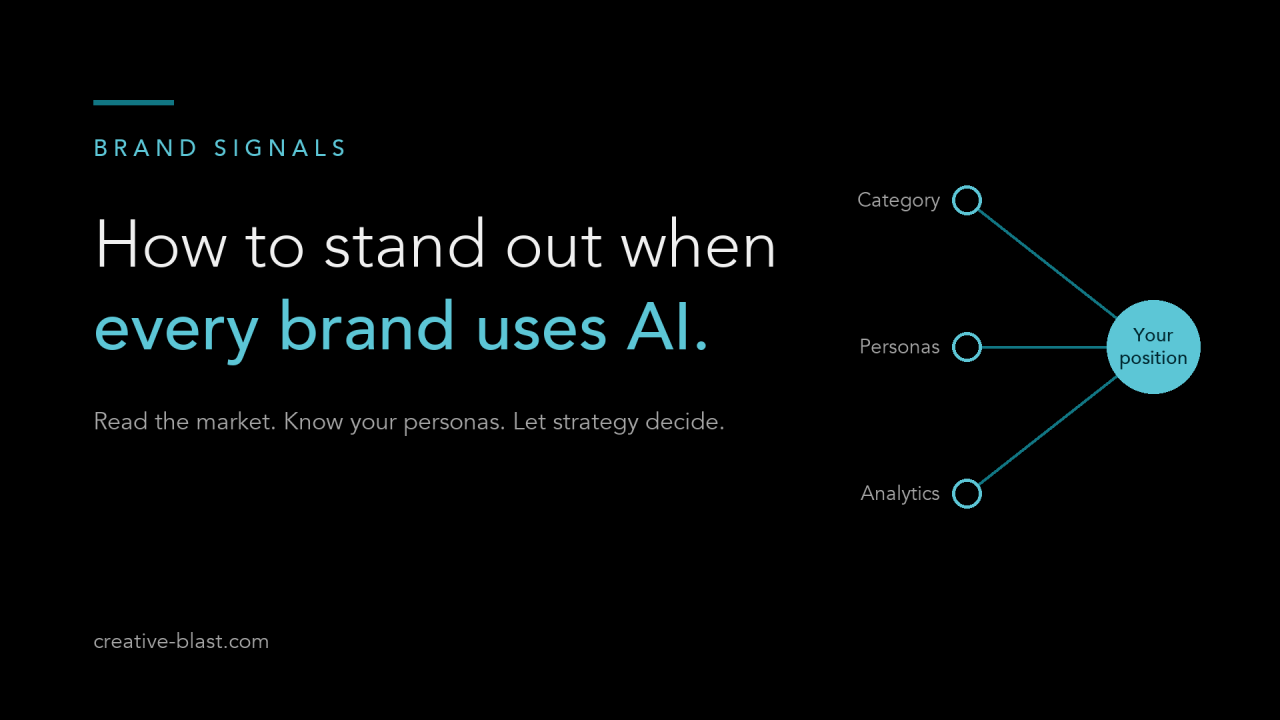
Open any feed today and you can feel it. The same glossy images. The same upbeat phrases. The same layouts, in slightly different colors. AI made it easy for every brand to produce more. It also made it easy for every brand to look like everyone else.
That is the vanilla problem. And it is not a technology problem. It is a strategy problem.
Why AI defaults to vanilla
Out of the box, AI tools are trained on everything, so their default output looks like everything. Ask ten teams for "a modern, friendly campaign image" and you get ten versions of the same image.
Inside a company, it gets worse. Sales, marketing, regional teams and agencies all prompt AI their own way, and each one writes its own version of the brand into a prompt box. The result is not one brand at scale. It is many slightly different brands, all drifting toward average.
More tools will not fix this. A better prompt will not fix it either. A prompt can only ask for what someone already knows to ask for. It can't decide what makes a brand different.
The fix: an engine with strategy at both ends
AI is a great tool. The brands that get the most from it treat it as one part of a system, with human strategy at the start and human craft at the end. Creative Blast calls that system an AI creative engine.
Human strategy in, human craft out. The engine scales everything in between.
It runs in four steps.
01 Brand context
Before any tool generates anything, someone has to decide what makes the brand unique. That is strategy, and it is human work: the insight, the positioning, the point of view.
Then that strategy becomes something every tool can read. Positioning, voice, the style guide and AI guidelines come together in one place, a brand brain. Every team and every tool starts from the same source instead of from someone's memory of the brand.
02 Real data
Design decisions should rest on data, not feelings. The brand brain is fed with real signals: analytics that show what audiences actually respond to, competitor audits that show what the category already looks and sounds like, and trend signals that show where the conversation is heading.
Competitor audits matter most here. To stand apart from a category, you have to know what it looks like. AI makes it cheap to produce options. Data shows which ones could work. Strategy decides which one is right for the brand.
03 AI design systems
This is where speed comes from. AI design systems turn the brand brain into templates, components and rules. Creative Blast builds them with Claude Code connected to Figma and Adobe, so the system works inside the tools design teams already use.
New assets start from something that is already on brand, not from a blank page. That is how on-brand assets get produced 90% faster. And the system only knows what's on brand because human strategy and design decisions shaped it first.
04 Human craft
The last step of every engine is a human. Every output is reviewed for:
- Distinctiveness. Could a competitor run it?
- Accuracy. Are the claims and details right?
- Licensing. Is it safe to use?
- Brand fit. Does it sound and look like the brand?
- Accessibility. Does it meet WCAG standards?
AI gets the work to the review faster. The craft is still finished by hand.
What changes for marketing and creative leaders
For CMOs and marketing leaders, the engine means more campaigns and assets without growing headcount, and one brand across regions, teams and agencies.
For creative leaders, it means using AI without handing over the brand. The rules live in the system, the taste stays with the team, and nothing ships without a human review.
For both, the question shifts from "how do we produce more?" to "how do we stay unique at speed?" Speed is the easy part. Staying unique at speed is the job.
Is your brand ready for AI?
Four questions to start with:
- Is your positioning written down clearly enough that a tool could follow it?
- Do all your teams and agencies work from the same brand context, or from their own?
- Do you know what your category looks like, so you can stand apart from it?
- Does every AI-made asset get a human review before it ships?
If any answer is "not yet," that is where to begin.
Creative Blast builds AI creative engines for brands in every industry, B2B and B2C. This quarter, the studio is offering a free 30-minute Brand AI Engine audit. In 30 minutes you get a clear view of where AI can scale your creative work and where it could make your brand generic, a check of whether your brand context is ready for AI tools, and the first steps toward a brand brain and an AI design system built for your brand.